Skip to content
MyKoreanTrip

Mountain park · South & North Jeolla

Naejangsan National Park

내장산국립공원

The country's most photographed autumn maples, in early November.

Naejangsan is not high — 763m at Sinseonbong — but for two or three weeks each autumn it is one of the busiest places in Korea. The maple tunnel on the approach to Naejangsa temple is the shot everybody comes for.

The ridge forms a horseshoe around the valley, and walking the rim is a good way to escape the crowds on the valley floor.

Getting there from Seoul

Door-to-door estimates for a normal day; they stretch on a holiday weekend. Check the timetable before you rely on a last bus back.

  • Train

    KTX to Jeongeup, about 1h 40m, then a local bus or taxi for the last 20 minutes. In peak foliage season extra services run.

  • Bus

    Express coach to Jeongeup, around 3h.

  • Car

    About three hours. Don't drive in the first two weeks of November unless you enjoy queueing — the approach road gridlocks.

Wildlife & plants

Animals

Wild boar and roe deer, plus a well-known colony of bats in the caves near Geumseon valley.

Trees & flowers

The reason to come. The maple tunnel on the approach to Naejangsa is around a hundred years old, and the park holds several maple species that turn at slightly different times, which stretches the season. Also a large natural stand of nutmeg yew.

Korea’s wildlife is shy and mostly nocturnal — you’re far more likely to see tracks than animals. Wild boar are the one to know about: keep your distance, don’t run, and never get between a sow and her young.

What grows and lives here

The mountain up close

Naejangsan is Korea’s autumn mountain. It has been famous for its maples for more than five hundred years, and the Joseon-era lists of the country’s eight great scenes included it for exactly this. Come in the first half of November and it is astonishing; come in July and it is a pleasant, quiet, green valley that nobody is looking at.

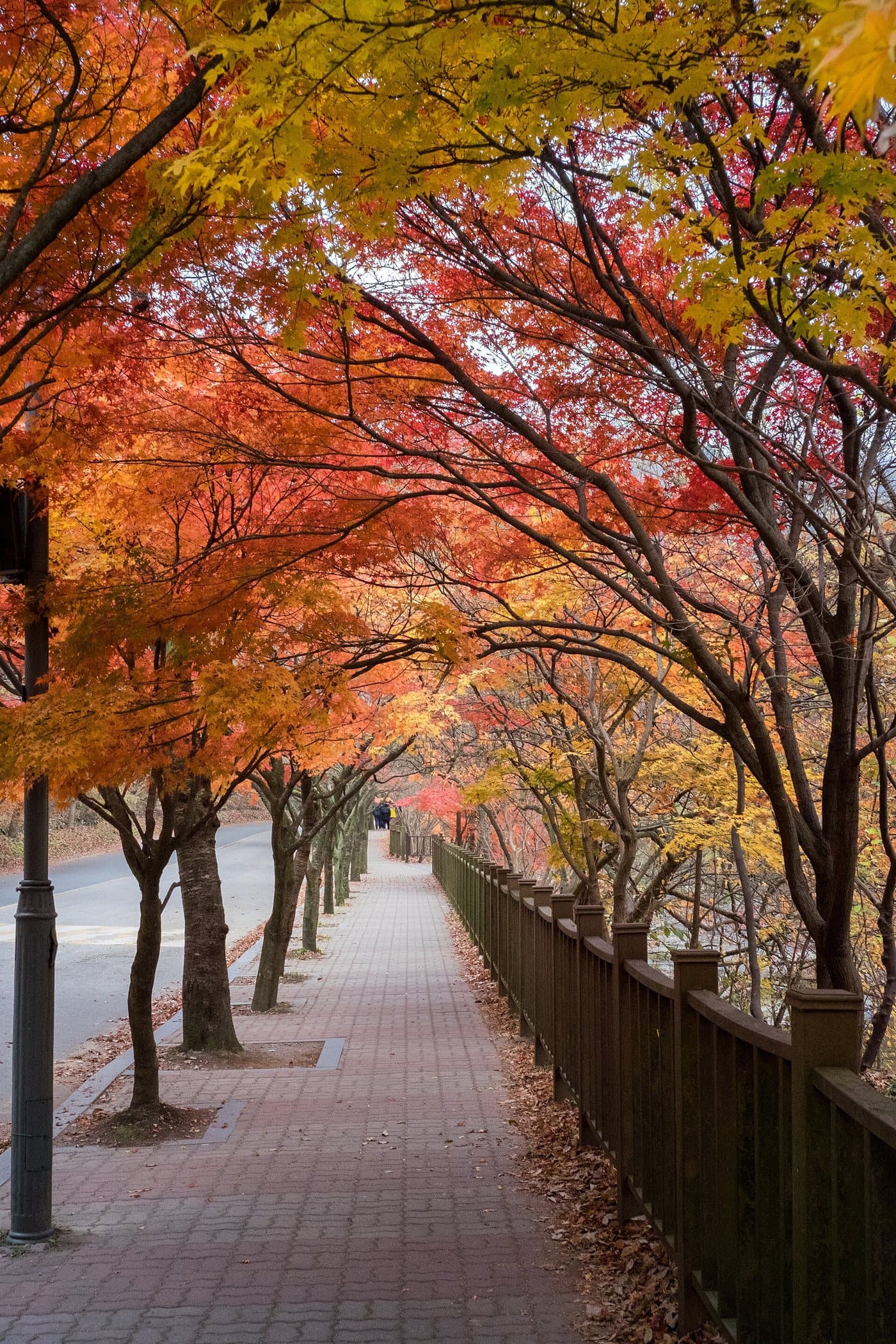
An avenue of maple trees in full red autumn colour arching over a walking path

The maple tunnel at the entrance

Naejangsan

Photo by Norton Ip, CC BY-SA 2.0

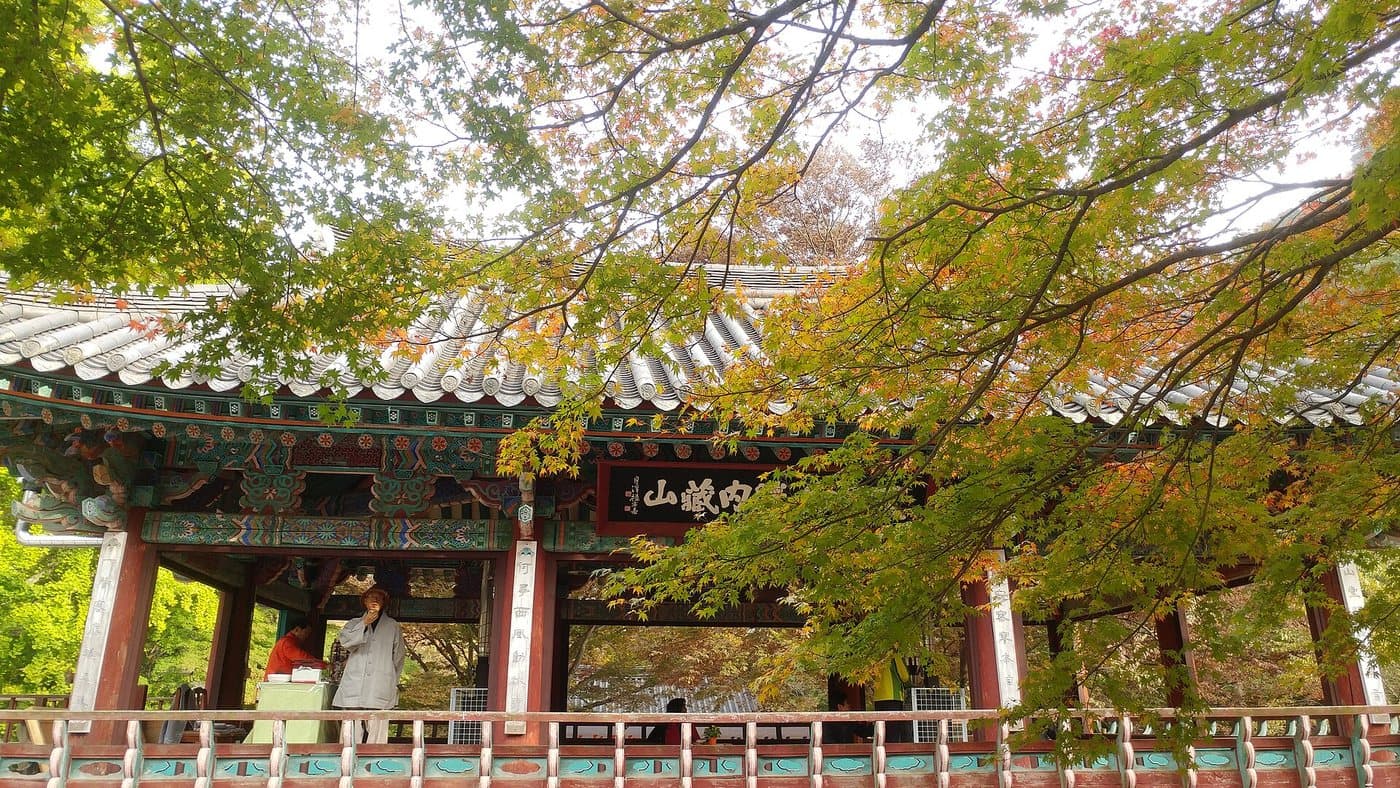
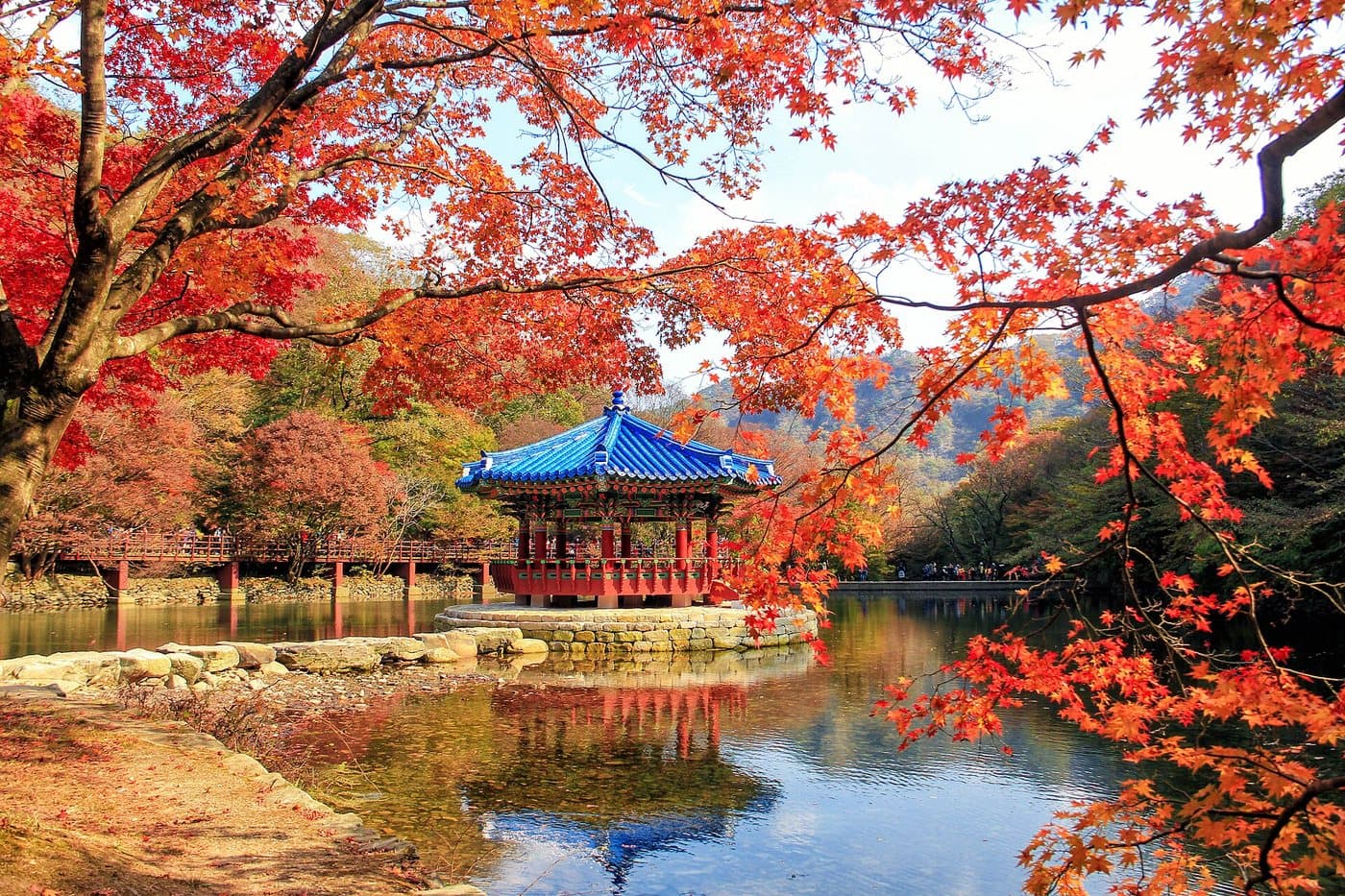
A wooden pavilion on a small lake framed by brilliant red maple leaves

Uhwajeong pavilion on its lake

Naejangsan

Photo by Tung Thanh Dang, CC BY-SA 3.0

Temple buildings among trees turning red and gold in autumn at Naejangsan

Autumn colour through the valley

Naejangsan

Photo by SHUNSHAN PIAO, CC BY-SA 3.0

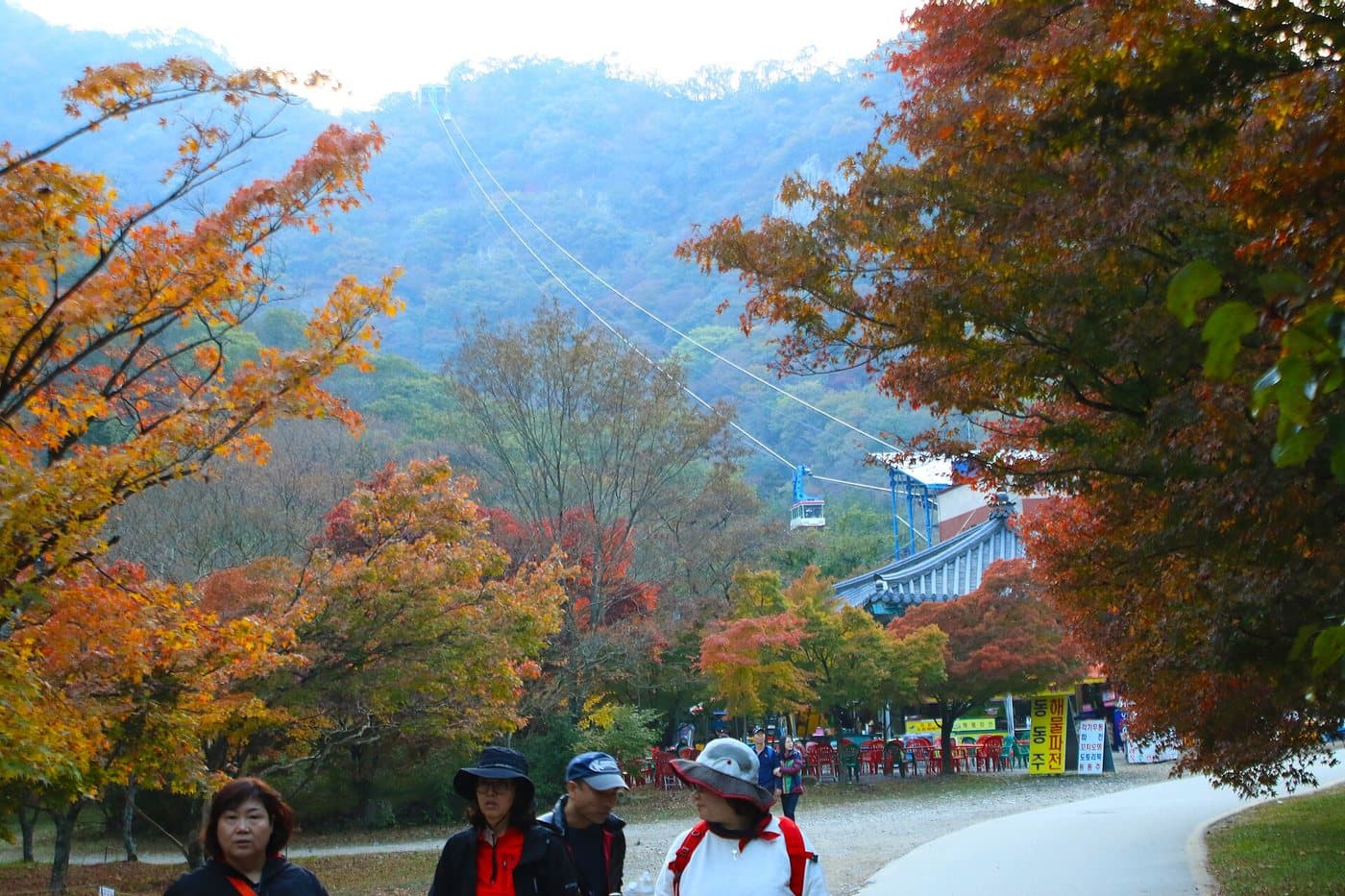
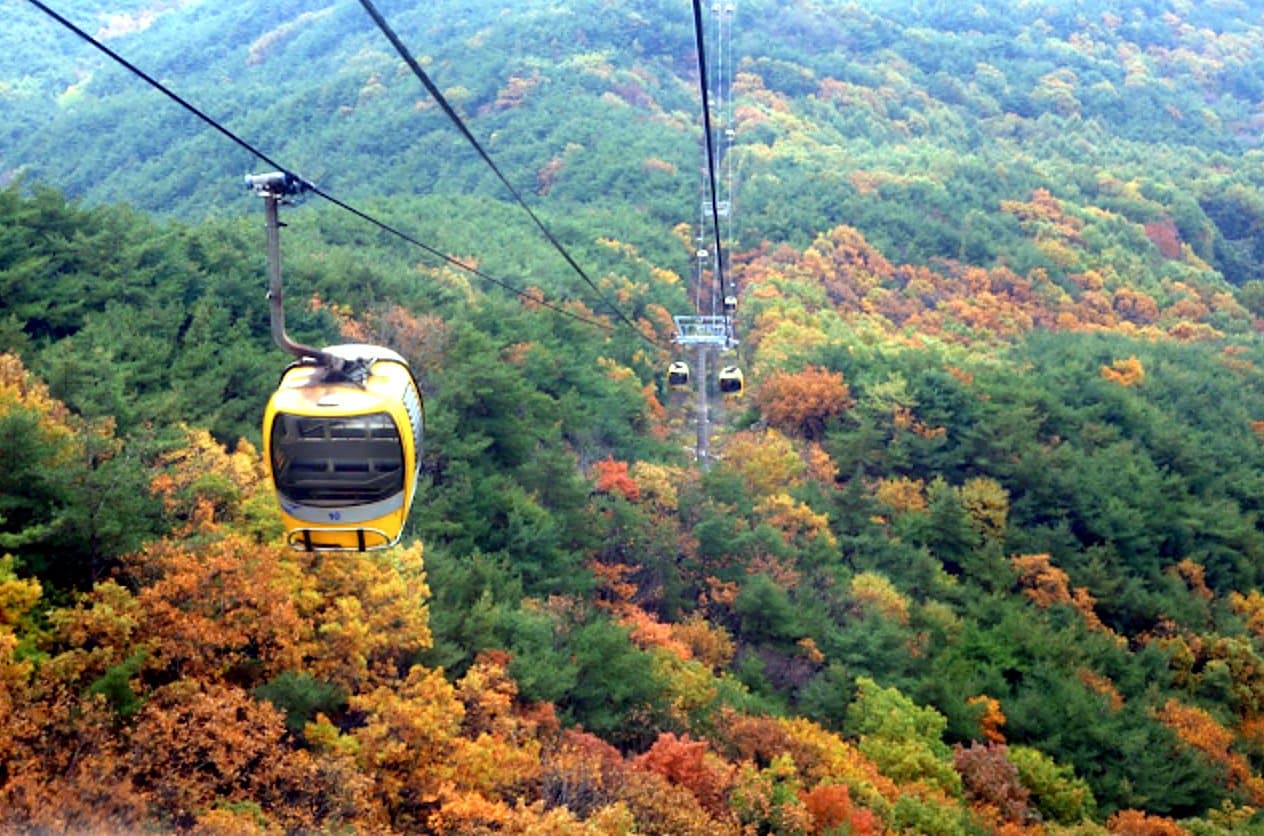
A cable car crossing above a valley of autumn foliage at Naejangsan

The cable car over the colour

Naejangsan

Photo by Jeongtaeyoung, CC BY-SA 3.0

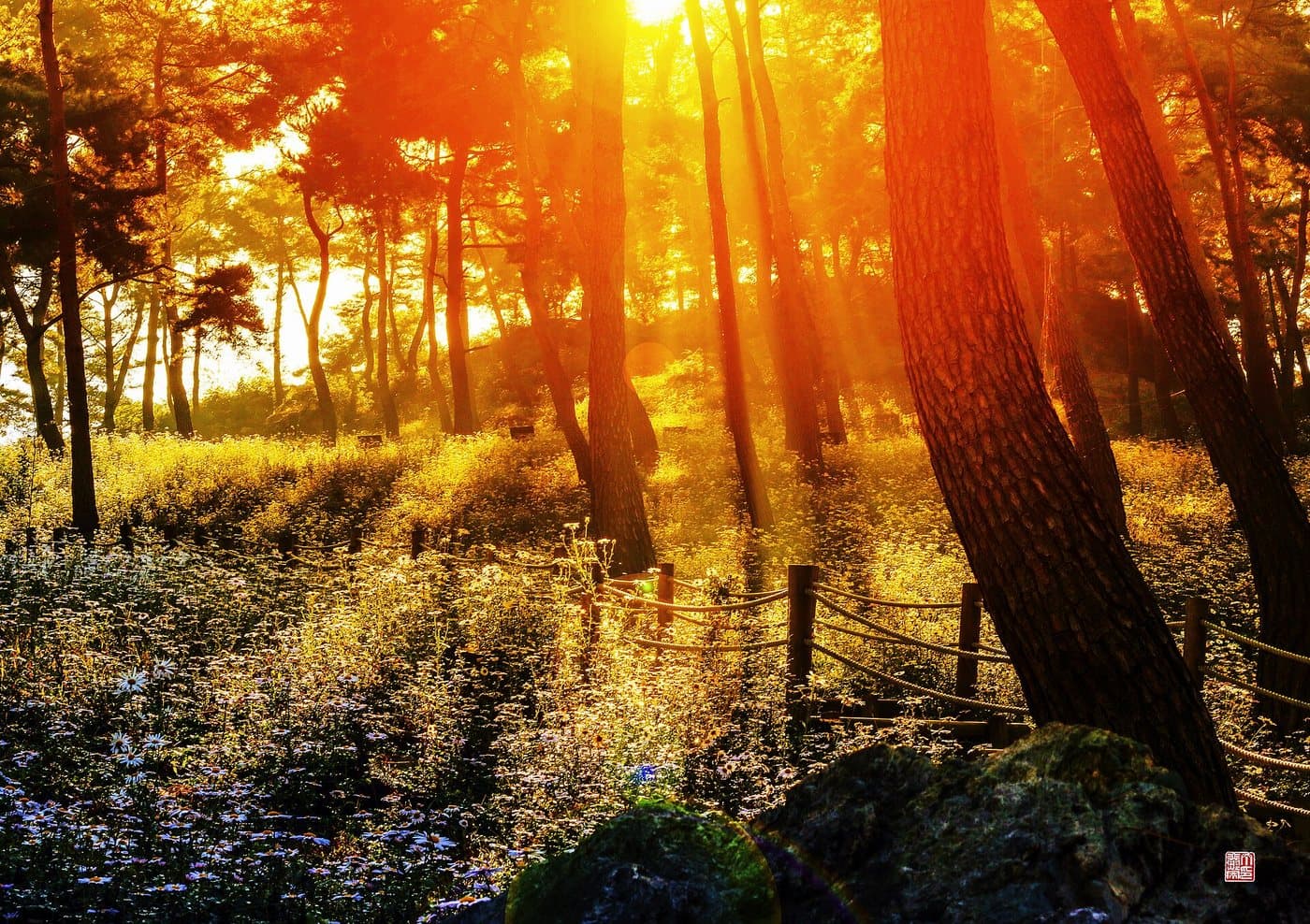
Low sun through pine trunks over a forest floor carpeted in small white chrysanthemum flowers

Gujeolcho, Korean chrysanthemum, under the pines

Naejangsan

Photo by Jeongtaeyoung, CC BY-SA 3.0

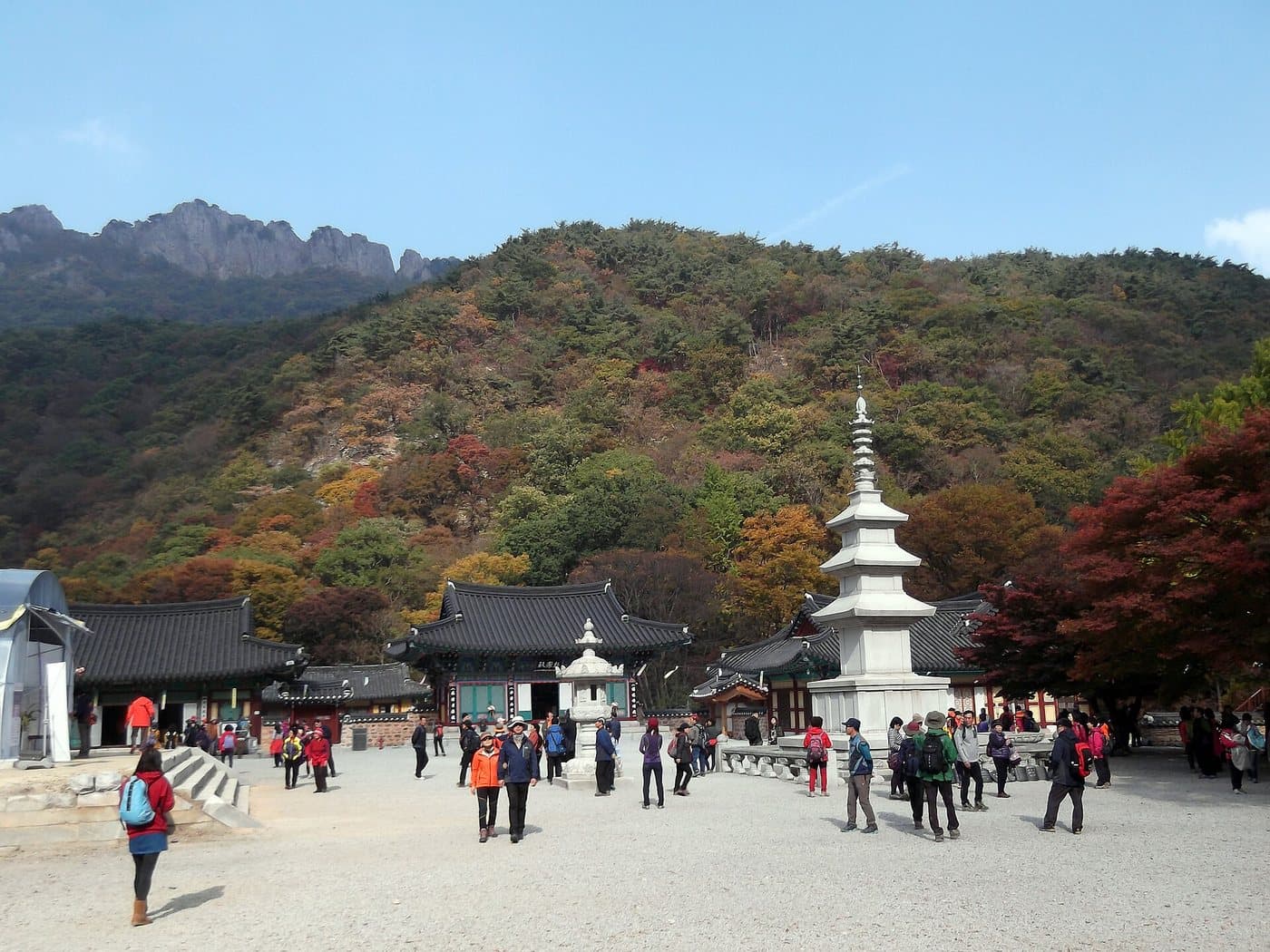
Naejangsa temple with a stone pagoda in the courtyard and wooded ridges behind

Naejangsa, at the head of the valley

Naejangsan

Photo by Café Bene, Public domain

Getting the timing right

Peak colour at Naejangsan usually lands between about the 5th and the 15th of November — later than most of Korea, because it is in the south-west and the valley holds its warmth. The Korea Forest Service publishes a foliage forecast each autumn and it is reliable to within a few days.

That fortnight is also when half the country turns up. Trains to Jeongeup and the shuttle to the park fill completely on November weekends, the walk from the gate to the temple becomes a slow-moving crowd, and the cable car queue can pass an hour. A weekday is a different mountain.

Walking it

From a stroll to the full horseshoe

Naejangsan is a bowl. A horseshoe of eight or nine peaks between roughly 620m and 763m rings a single valley, with the temple at the head of it, and almost everything worth seeing is either along the valley floor or around that rim.

The maple tunnel and Naejangsa

What most visitors actually do

Distance
3 km
Time
1–2 hr return
Grade
easy

Route: Main gate → maple avenue → Uhwajeong pavilion → Naejangsa temple

Getting to the start: Train to Jeongeup, then a local bus or taxi to the park gate — about 20 minutes.

Flat, paved, pushchair-friendly and the reason the park is famous. The avenue of maples near the entrance is the photograph everyone has seen. A shuttle runs the last stretch to the temple in peak season if you would rather not walk it.

Cable car to Yeonjabong

The view without the climb

Distance
0.7 km
Time
5 min each way
Grade
easy

Route: Lower station → Yeonjabong observation deck

Getting to the start: Near the temple, at the head of the valley.

Lifts you onto the rim for the view down into the bowl. In the first fortnight of November expect a serious queue; tickets are sold on the day only.

Bulchulbong

The short climb to a real view

Distance
4 km
Time
2–3 hr return
Grade
average

Route: Valley floor → Bulchulbong (622m) → back the same way

Getting to the start: Signed from the main valley path.

A proper hill walk that gets you above the crowd in about an hour of climbing. The best value on the mountain if you want the view from the rim and only have a morning.

Sinseonbong and the summit

The high point

Distance
8 km
Time
4–5 hr return
Grade
advanced

Route: Valley floor → Sinseonbong (763m) → return

Getting to the start: From the temple end of the valley.

Sinseonbong is the true summit of Naejangsan. Steep in sections with steps and rope handrails, and quiet compared with everything below.

The full ridge horseshoe

The whole rim in a day

Distance
11 km
Time
6–7 hr
Grade
advanced

Route: Up one side of the bowl, round the peaks, down the other

Getting to the start: Start early from the main gate.

The complete circuit of the ring of peaks around the valley — a long, undulating day with a lot of short sharp climbs between summits rather than one big ascent. Carry water; there is little on the ridge.

Distances are approximate and one way unless stated; the valley paths are well signed from the main gate.

Five hundred autumns

Why this valley, and not another

1971
Designated
81.7 km²
Area
763 m
Summit
≈5–15 Nov
Peak colour

Naejangsan became a national park in 1971 and covers 81.7 km² around Jeongeup in North Jeolla. By Korean standards it is small and it is not especially high — Sinseonbong tops out at 763m. What it has is a shape.

The valley is a closed bowl ringed by peaks, which traps warmth and shelters everything inside from wind. That combination lets a very dense stand of maple grow right down the valley floor, and it holds the leaves longer and turns them harder than an exposed hillside would. The result has been famous since the Joseon dynasty, when the mountain was named among the country’s eight great scenes.

The species doing most of the work is the Korean maple, along with the danpung maples planted along the entrance avenue over the last century. The avenue is the photograph the whole country recognises: a few hundred metres of trees meeting overhead, going crimson from the top down.

At the head of the valley is Naejangsa, founded in 636 under the Baekje king Mu. It has burned down four times. The main hall went in the Korean War and was rebuilt in 1958, burned again in 2012 through an electrical fault, and was destroyed a fourth time in March 2021 in an arson attack by a monk who was later arrested.

That last rebuild finished recently: the new main hall was consecrated in April 2026, paid for entirely by the temple, and this time treated against fire. So the hall you will see is brand new — which is oddly in keeping with a building that has been renewed roughly every other generation since the seventh century.

Baegyangsa, over the ridge on the southern side of the park, was founded in 632 and is the other great temple here — every bit as good in November, with rather fewer people in front of it.
More parks

All 23 national parks →