
Mountain park · South & North Jeolla, South Gyeongsang
Jirisan
지리산국립공원
Korea's first national park, and the highest ground on the mainland.
Designated in 1967, Jirisan was the first place in the country to be made a national park, and it is still the largest on land. Cheonwangbong, at 1,915m, is the highest summit in mainland South Korea.
The classic outing here is the ridge traverse — several days along the spine of the massif, sleeping in the mountain shelters, which have to be booked in advance. It is also the heart of the programme to reintroduce the Asiatic black bear.
Photograph by eimoberg, licensed under CC BY 2.0. Resized for this page.
Getting there from Seoul
Door-to-door estimates for a normal day; they stretch on a holiday weekend. Check the timetable before you rely on a last bus back.
Bus
Express bus from Seoul Nambu or Central City to Gurye (about 3h 30m) for the western side, or to Jinju then a local bus for the Jungsan-ri approach in the south-east. There is no single "Jirisan" stop — pick your trailhead first, then the town that serves it.
Train
KTX to Namwon (about 2h 10m) is the fastest way to the northern side, then a local bus to Baemsagol or Jeongnyeongchi.
Car
Around four hours from Seoul on the Honam or Tongyeong-Daejeon expressways. Worth it here, because the trailheads are spread across three provinces and the bus links between them are slow.
Wildlife & plants

Animals
The centre of Korea's Asiatic black bear reintroduction — a wild population lives here again after the species was all but wiped out. Also otters, yellow-throated martens, wild boar and the flying squirrel. Around 40 mammal species and several hundred birds have been recorded.
Trees & flowers
Korean fir (Abies koreana) on the high ridges, a species found naturally only in Korea and now retreating upward as the climate warms. Royal azalea colours the slopes in late spring, and the valleys hold old mixed broadleaf forest.
Korea’s wildlife is shy and mostly nocturnal — you’re far more likely to see tracks than animals. Wild boar are the one to know about: keep your distance, don’t run, and never get between a sow and her young.
Wildlife story
The bears of Jirisan
Deep in the forests of Jirisan lives one of South Korea’s rarest large wild animals — the Asiatic black bear (Ursus thibetanus). In Korean they are 반달가슴곰 (bandalgaseumgom), roughly “half-moon chest bear”, after the white crescent across the chest.
- 2004
- Restoration programme began
- 6
- Bears in the first release
- 2009
- First cubs born wild
- 86
- Wild bears, 2024
Are the bears native to Korea?
Yes. Asiatic black bears lived throughout the Korean peninsula historically, alongside Amur leopards and Siberian tigers. The bears of this part of north-east Asia are the subspecies Ursus thibetanus ussuricus, whose natural range covers the peninsula, north-eastern China and the Russian Far East.
They are a genuine native species — not an animal brought in to make an attraction.
So why were bears released?
Because the original population had all but gone. Hunting, poaching, habitat loss and Korea’s rapid development collapsed bear numbers over generations — they were hunted during the Japanese colonial period, and suffered again around the Korean War and in the decades after it.
By the start of this century researchers believed only a handful survived in Jirisan. Then, in 2000, a television documentary team filmed wild bears in the park and proved some were still there. Rather than let the remnant disappear, Korea decided to rebuild it.
The restoration programme
The programme proper began in 2004, when six young bears from the Primorsky region of the Russian Far East were released here. That was not an arbitrary choice: genetic work found that bears from the Russian Far East and North Korea belong to the same broad group as the peninsula’s historic population.
Bears from Russia, North Korea and north-eastern China followed, along with suitable animals from captivity in Korea. The aim was never simply to put animals on a mountain — it was a self-sustaining wild population that breeds on its own. It worked.
The target of 50 bears was hit in 2018, two years early. By August 2024 the count was 86 in and around Jirisan. Most of them were never released by anyone: they were born wild, the first cubs of the modern programme recorded from 2009. Some have since moved beyond Jirisan along the ridge, including towards Deogyusan.
What do they actually eat?
Not people. They are omnivores, but the great majority of the diet is plant material — a study of droppings collected in the park between 2005 and 2013 put it at 77%.
- Plants77%
- Insects12.8%
- Mammals5.6%
- Birds, arthropods, other4.6%
Will you see one? Almost certainly not
Eighty-odd bears across 472 km² of dense forest, and they avoid people. Most park staff go years without a sighting. Encounters are rare enough to make the national news when they happen.
If you do meet one: don’t run, don’t shout, don’t turn your back. Back away slowly while facing it and give it a route out. Keep to marked trails, don’t leave food or rubbish at the shelters, and make a bit of noise on blind corners so nothing is surprised at close range.
More parks
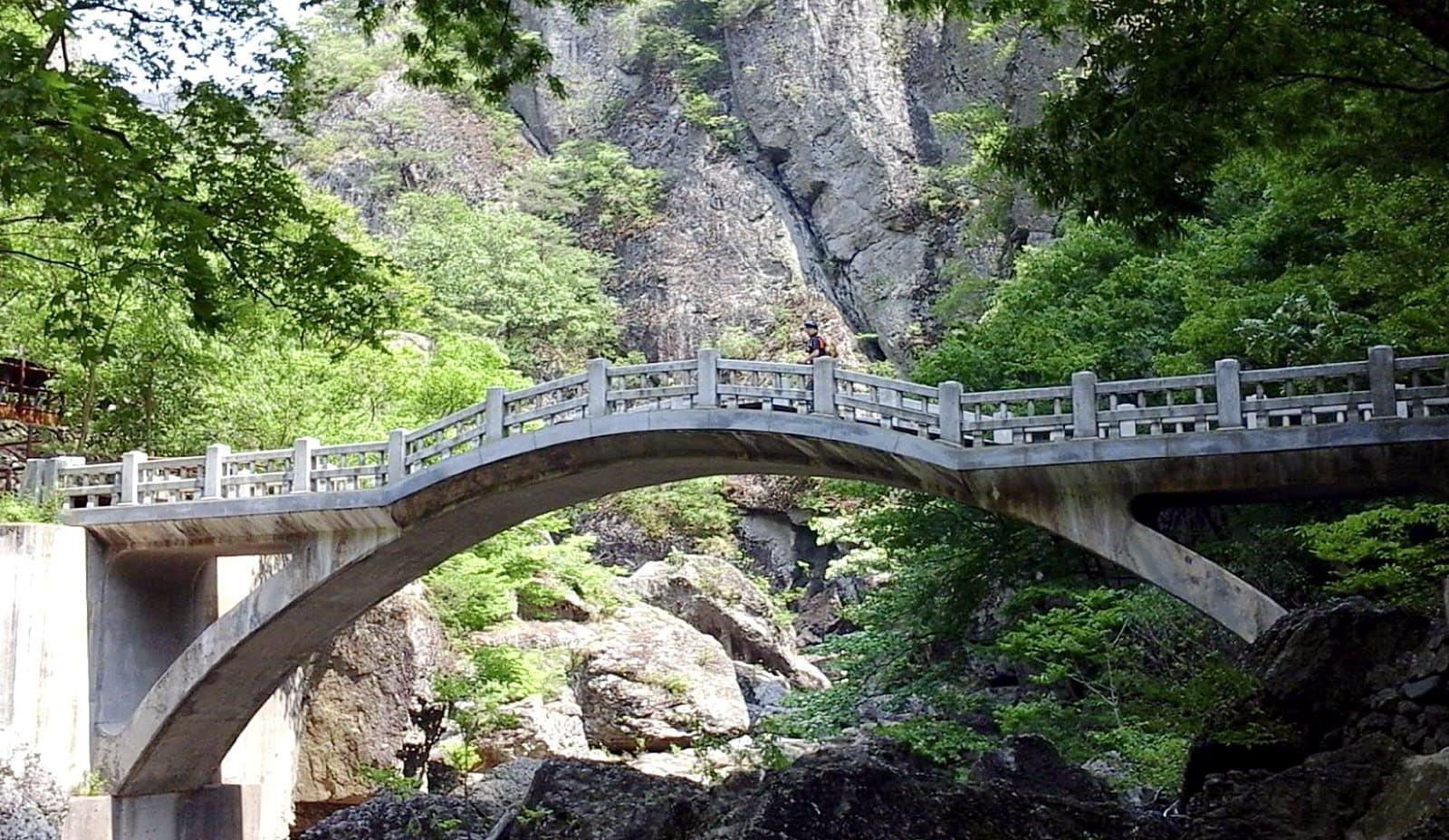
Juwangsan
Rock gorges, waterfalls and the reflecting pond at Jusanji.
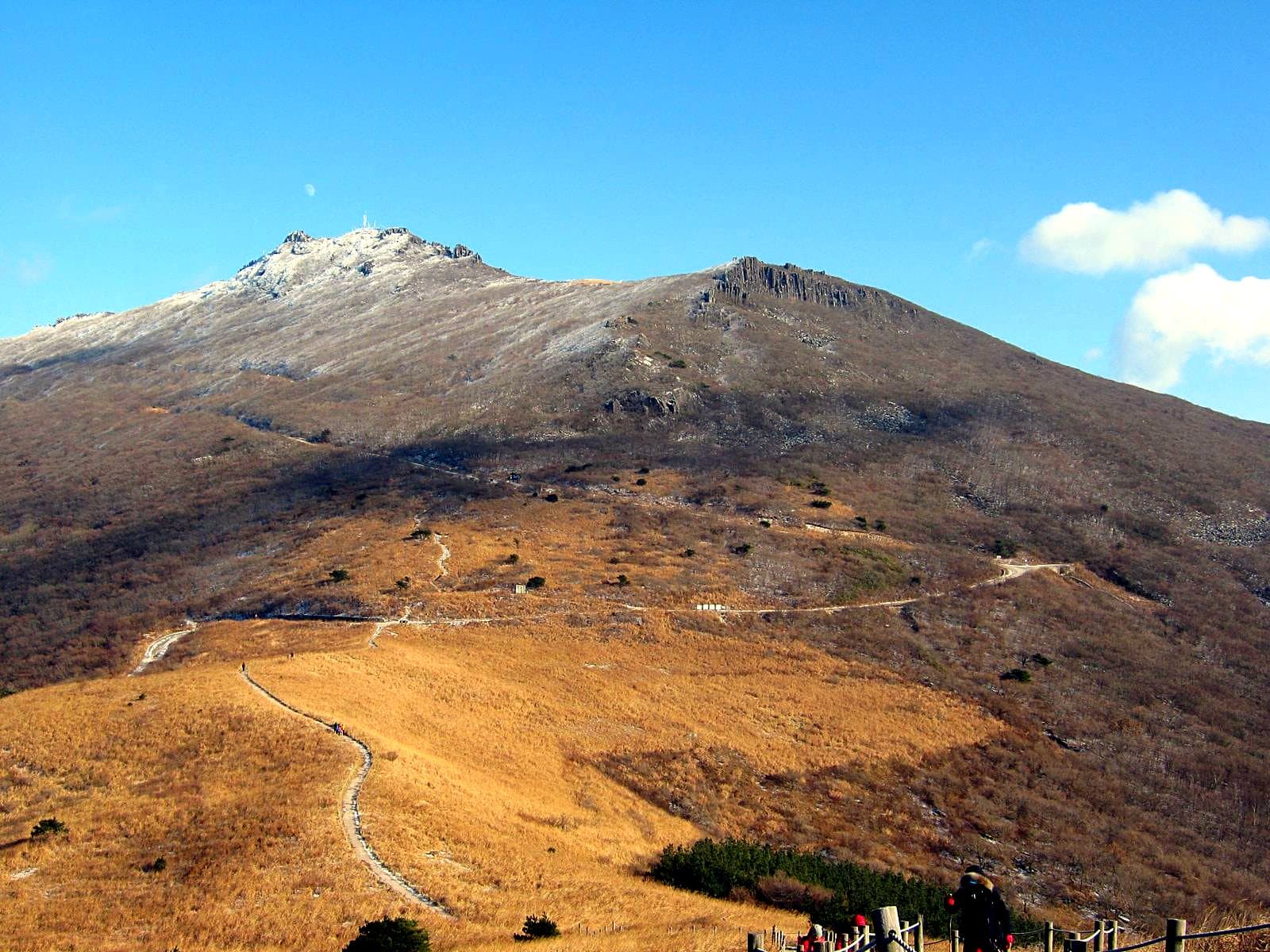
Mudeungsan
Gwangju's mountain, with columns of volcanic rock along the ridge.

Naejangsan
The country's most photographed autumn maples, in early November.