Korea has some of the fastest, most reliable internet infrastructure anywhere in the world, and it shows the moment you land — this is one thing that's genuinely easier here than at home for most visitors.
Free public Wi-Fi
Free Wi-Fi is widespread: cafés (Starbucks and every local coffee shop), convenience stores, subway stations and trains, airports, and most hotels and guesthouses all offer it, usually with no login hassle beyond a splash screen. Seoul also runs a free public network (Public WiFi Seoul / SEOUL WiFi) covering large parts of the subway system and many public spaces around the city.
SIM, eSIM & mobile data
Public Wi-Fi is fine for checking a map at a café table, but it's patchy for actually navigating a city — you need data that works on the street, between stops, underground on the subway, and hiking a mountain trail. Three options, cheapest effort last:
- eSIM — activate before you even land, no airport queue or physical card to swap in.
- Prepaid SIM — picked up at a kiosk in the arrivals hall if you'd rather have a physical card.
- Pocket Wi-Fi ("egg") — a small shared device, usually the cheaper option if several people are travelling together and splitting the cost, rather than everyone buying their own SIM or eSIM.
What to expect from coverage
Mobile coverage from Korea's three major carriers (SKT, KT, LG U+) is excellent almost everywhere a visitor goes, including deep in the Seoul subway and on most mountain trails in the national parks. Rural, mountainous stretches can occasionally drop to a weaker signal, but genuine dead zones are rare compared to most countries.
A couple of practical notes
- Bring your own portable charger — heavy map and translation-app use drains a phone fast, and while convenience stores sell chargers, it's one less thing to think about.
- Public Wi-Fi and a local SIM/eSIM both still leave you needing to charge your phone on the same plug as everything else — see below if you're packing a charger from home.
Plugs & electricity
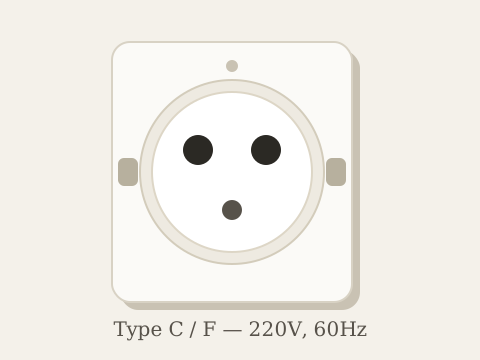
Korea runs on 220V, 60Hz, using Type C and Type F plugs — two round pins, the same shape used across most of continental Europe.
- Coming from the US, UK, Australia, or Canada: yes, a plug adapter is essential — your plug shape won't fit Korean sockets at all.
- Coming from continental Europe: usually no adapter needed, since Type C/F plugs are shared.
- Voltage: most modern electronics (phone chargers, laptop chargers, camera batteries) are dual-voltage (100–240V) and will work fine on Korea's 220V without a separate converter — check the small print on the charger brick for "INPUT: 100-240V" to confirm. Anything single-voltage from a 110V country (some hairdryers and straighteners) needs a real voltage converter, not just a plug adapter, or it can be damaged.
A universal travel adapter covers you if you're continuing to other countries; if Korea is your only stop, a cheap Type C/F-specific adapter from any electronics store, convenience store chain, or Incheon Airport itself will do the job for a couple of dollars.